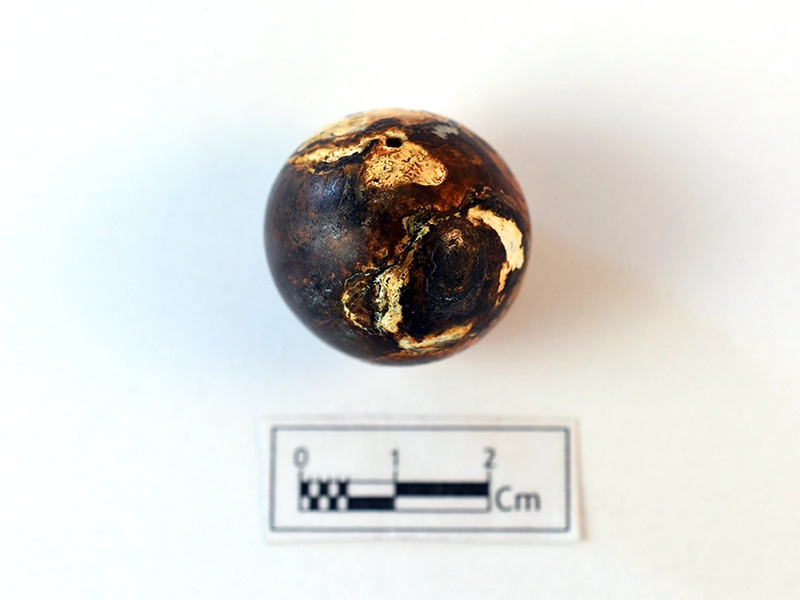
Spherical Bead-
- காலகட்டம்
- Historical
- திகதி/காலம்
- 2025-08-28
- பயன்படுத்தப்பட்ட மூலப்பொருட்கள்
- Carnelian
- அளவுக் குறியீடுகள் (பரிமாணங்கள்)
- L-24.57cm, W-26.41cm, DM-1.33mm
- கண்டெடுக்கப்பட்ட தளம்
- Godawaya Shipwreck
- தற்போதைய இருப்பிடம்
- Conversation Labotory
- பதிவு எண்
- 2025/SL/S/GDV/M/002/017
முழுமையான விளக்கம்
Slightly rolled
ground, rough
both side perforation
One Drill hole not finished
ground, rough
both side perforation
One Drill hole not finished
வரலாற்றுப் பின்னணி
Beads from the Godawaya Shipwreck
The beads are a small but unique assemblage of artifacts recovered from the Godawaya shipwreck. This remarkable collection of 57 beads is the first assemblage of its kind ever recovered from an underwater archaeological site in Sri Lanka. Crafted in elegant forms such as spherical and oblate discs, the beads were made from semi-precious stones including carnelian, agate, and also marine coral.
Similar carnelian beads, have been unearthed from excavations at megalithic cemeteries like Ibbankatuwa, monastic sites such as Jetavana, and ancient urban centers and ports including Tissamaharama, Anuradhapura, and Manthai. Since carnelian does not occur naturally in Sri Lanka, these finds highlight long-distance trade connections, most likely with the Deccan region of India and Southeast Asian region.
Microscopic studies show that the beads were perforated using diamond-tipped drills, a sophisticated technique of the time. Further morphological analysis suggests that the beads were unused when the ship sank, indicating they were probably part of a cargo intended for exchange rather than personal ornament.
Together, Godawaya beads provides a unique opportunity to examine ancient bead manufacturing techniques and Sri Lanka’s pivotal role in the wider Indian Ocean exchange network.
The beads are a small but unique assemblage of artifacts recovered from the Godawaya shipwreck. This remarkable collection of 57 beads is the first assemblage of its kind ever recovered from an underwater archaeological site in Sri Lanka. Crafted in elegant forms such as spherical and oblate discs, the beads were made from semi-precious stones including carnelian, agate, and also marine coral.
Similar carnelian beads, have been unearthed from excavations at megalithic cemeteries like Ibbankatuwa, monastic sites such as Jetavana, and ancient urban centers and ports including Tissamaharama, Anuradhapura, and Manthai. Since carnelian does not occur naturally in Sri Lanka, these finds highlight long-distance trade connections, most likely with the Deccan region of India and Southeast Asian region.
Microscopic studies show that the beads were perforated using diamond-tipped drills, a sophisticated technique of the time. Further morphological analysis suggests that the beads were unused when the ship sank, indicating they were probably part of a cargo intended for exchange rather than personal ornament.
Together, Godawaya beads provides a unique opportunity to examine ancient bead manufacturing techniques and Sri Lanka’s pivotal role in the wider Indian Ocean exchange network.